Gro Folkan

Petru Russu
Founder, editor and publiser of World of Art (WOA)
Contemporary Art Magazine
The leding art magazine along with ArtNews and Art in America and the book series Masters of Today (MOT).
2026


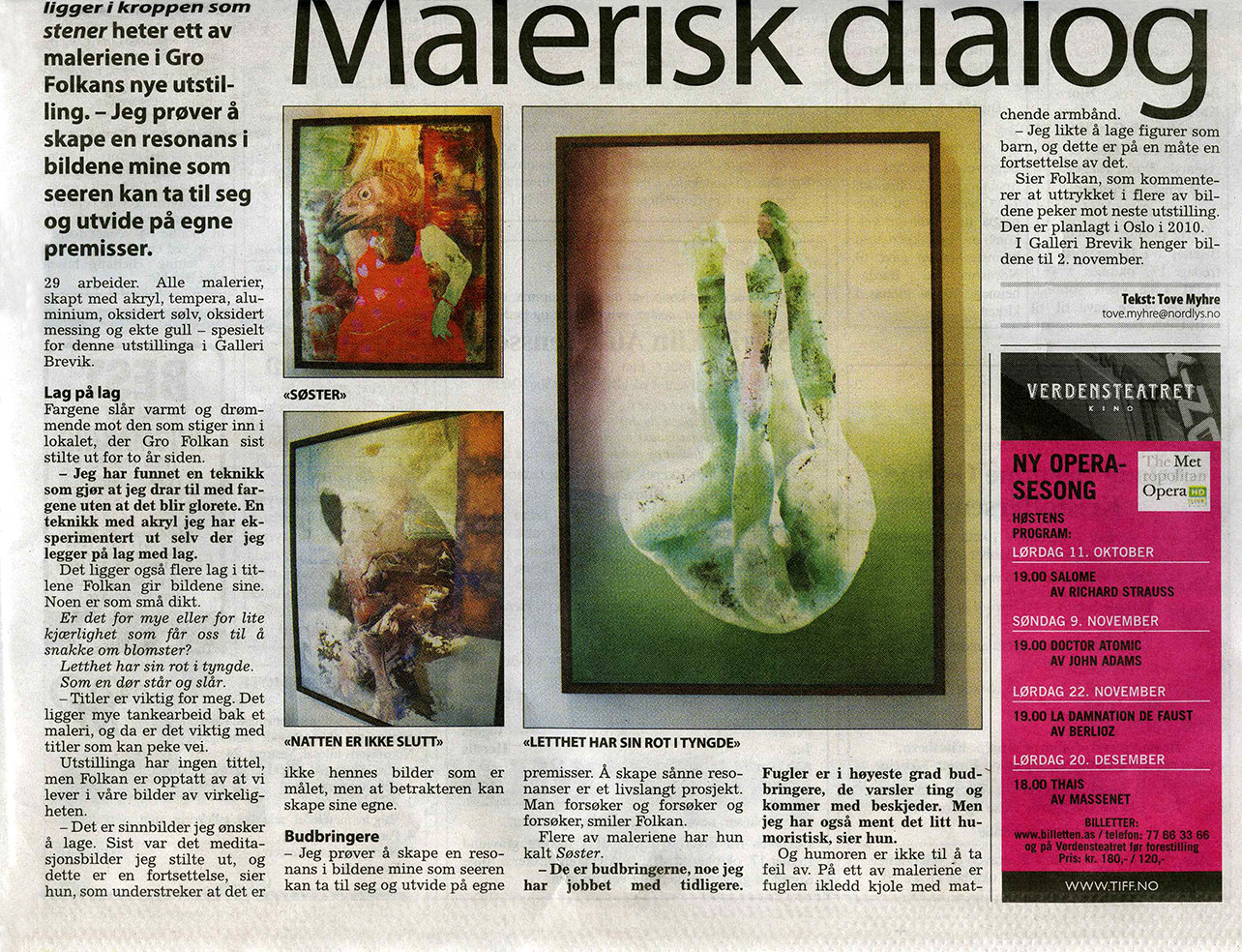
Gro Folkan’s art unfolds as a sustained meditation on matter, myth, and the invisible forces that shape human experience. Her paintings do not simply present images; they enact a slow ritual of transformation in which metals oxidize, pigments shift, and surfaces breath with an inner luminosity. Whal emerges is a visual language rooted in Nordic sensibility yet liberated from regionalism, a language that fuses archaic symbolism with contemporary abstraction, feminine cosmology with material alchemy.

Folkan’s canvases feel as if they have been excavated from a deeper stratum of cultural memory, carrying with them the traces of time, weather, and spiritual resonance.

Her artistic tendency gravitates toward the threshold between the physical and the metaphysical. She works with materials that change, and tarnish, and shimmer, allowing chemical processes to become part of the artwork’s meaning. Oxidized brass, copper, rust, and metal dust are not decorative additions but active participants in the painting’s evolutions. They introduce a temporal dimension: the surface becomes a site where matter records its own history. This approache aligns her with a lineage of artists who embrace entropy and transformation, yet Folkan’s sensibility is distinctly lyrical. Her metals do not corrode into decay; they even the most weathered materials carry a latent radiance.

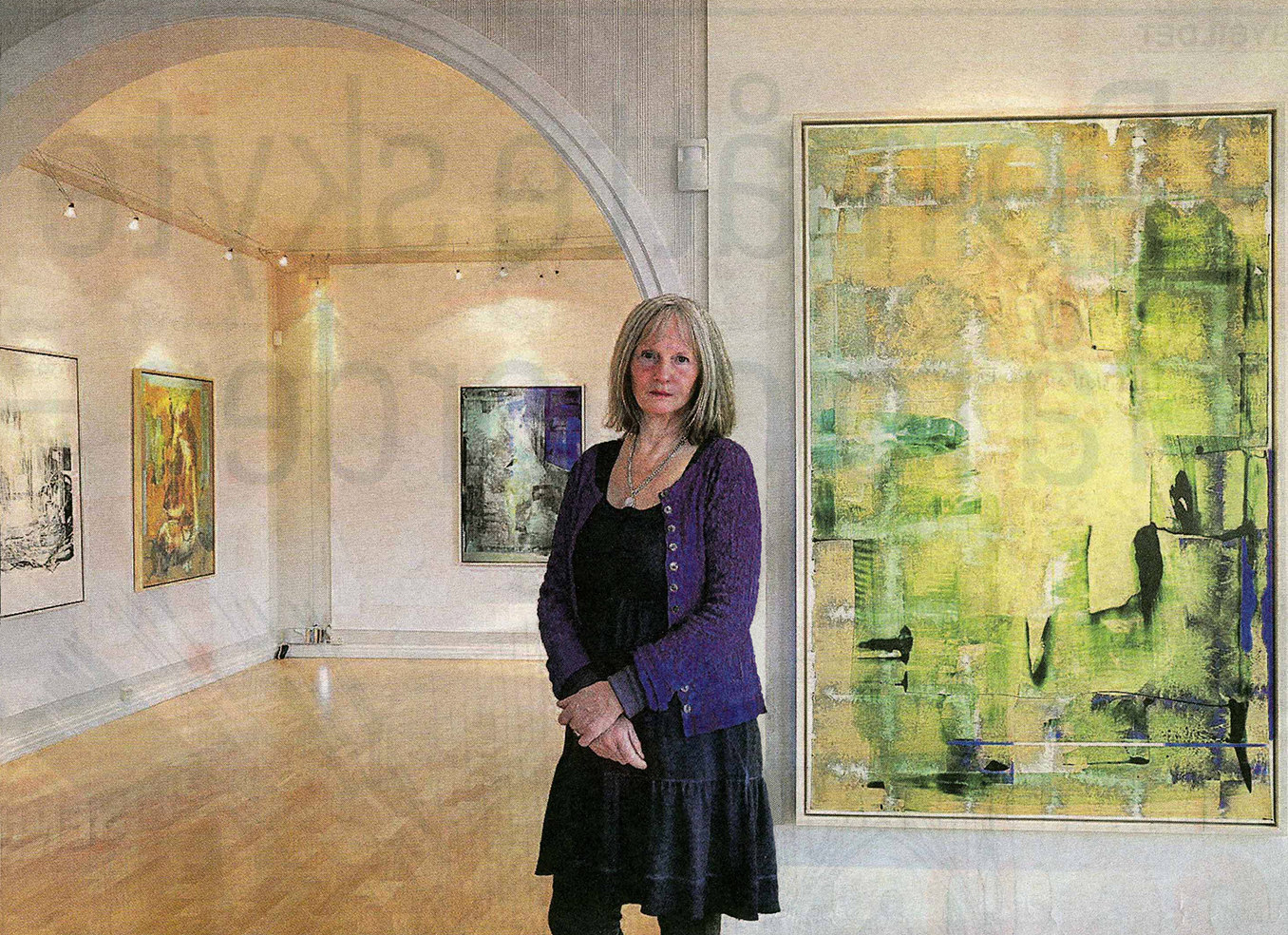
This interplay between opacity and luminosity is central to her visual language. Folkan oftenjuxtaposes earthy, tactile textures with interference colors that shift according to the viewer’s movment. The result is a dynamic tension between weight and light, between the grounded and the ethereal. Her paintings seem to hover between worlds, as if the surface were a membrane through which unseen energies pulse. This quality is especially evident in work such as ‘Aurora§, where the canvas becomes a field of atmospheric vibration. The use of gold and axidized brass evokes both the celestial and the the terrestrial, while interference pigments introduce a spectral shimmer reminicent of the Northern Lights. The painting does not depict an aurora; it enacts one. It captures the sensation of light in motion, of color dissolving into air, of a natural phenomenon that is a once physical and mystical. In ‘Aurora’, Folkan’s material choices become metaphors for trancendence: the tarnished metals speak of earthly time, while the luminous pigments gesture toward the eternal.

A different but equally potent dimension of her work emerges in ‘Female Rune’.

Here, Folkan turns to the symbolic heritage of the North, invoking the ancient runic alphabet as a vessel of feminine power. The rune becomes a sign of identity, protection, and ancestral memory, yet Folkan1s interpretation is not archaeological. She reimagines the rune as a contemporary emblem of the feminine principle, an abstracted form that that carries both strenght and vulnerability. The oxidized brass and copper introduce a patina of age,suggesting that the feminine is not a modern invention but a force that has persisted across centuries, weathered by time yet unbroken. The disciplined geometry of the rune contrasts with the organic textures surrounding it, creating a dialogue between structure and intuition. The painting reads as a quiet invocation, a visual mantra that resonates with the viewer on a symbolic level. It is nott a representation of womanhood but an embodiment of its enduring presence.

In ‘Don’t Turn Your Back to it’, Folkan adopts a more confrontational tone. The title itself functions as a warning, urging the viewer to face what is often avoided. The materials, rust, metal dust, interference color, create a surface that feels both wounded and resilient. Rust introduces a sense of vulnerability, a reminder of decay a surface that feels both wounded and resilient. Rust introduces a sense of vulnerability, a reminder of decay and passage of time, while the shimmering pigments suggest hidden beauty and transformation. The painting becomes a metaphor for the aspects of life, history, or identity that demand acknowledgment. It insists on visibility, on engagement, on the courage to confront what lies beneath the surface. The tension between deterioration and radiance and recognition.

Folkan’s material choices thus become emotional registers, translating inner states into tactile form.

Across these works, Folkan’s art reveals a consistent preoccupation with the idea of the threshold-between light and shadow, past and present, body and spirit. Her surfaces often resemble veils, skins, or portals, hinting at inner worlds that remain partially concealed. She does not depict the human figure, yet her paintings are imbued with a distinctly feminine presence. This presence is not literal but atmospheric, expressed through gesture, texture, and symbolic geometry. It is a presence that feels ancient, intuitive, and deeply connected to the rhythms of nature. Folkan’s art suggests that the feminine is not merely a biological category but a cosmological force, a way of perrceiving and shaping the woeld. Her position within contemporary art is marked by a unique synthesis of tendencies. She shares affinities with material-based abstraction, where process and surface are fregrounded, yet her use of metals introduces a symbolic dimension that sets her apart. She engages with Nordic mysticism, drawing on the atmospheric qualities of Northern landcapes and mythologies, but her work transcend regional identity through its universal themes of transformation and memoru. She aligns with feminist abstraction, articulating a feminine presence without resorting to figurative representation. And she echoes post-minimalist sensibilities through her balance of restraint and expressive texture.

Ultimately, Gro Folkan’s art proposes that matter is never inert. It remembers, transforms, and speaks. Her paintings invite the viewer into s space where the visible and the invisible converge, where surfaces reveal their histories, and where materials become metaphors for the human condition. They ask us to look closely, to remain attentive, to recognize the beauty in processes that unfold slowly and often imperceptibly. In a world dominated by speed and spectacle, Flokan1s work offers a counterpoint: a quioet, resonant affirmation of the power of transformation, the persistence of memory, and the enduring presence of the feminine as a guiding force in both art and life.

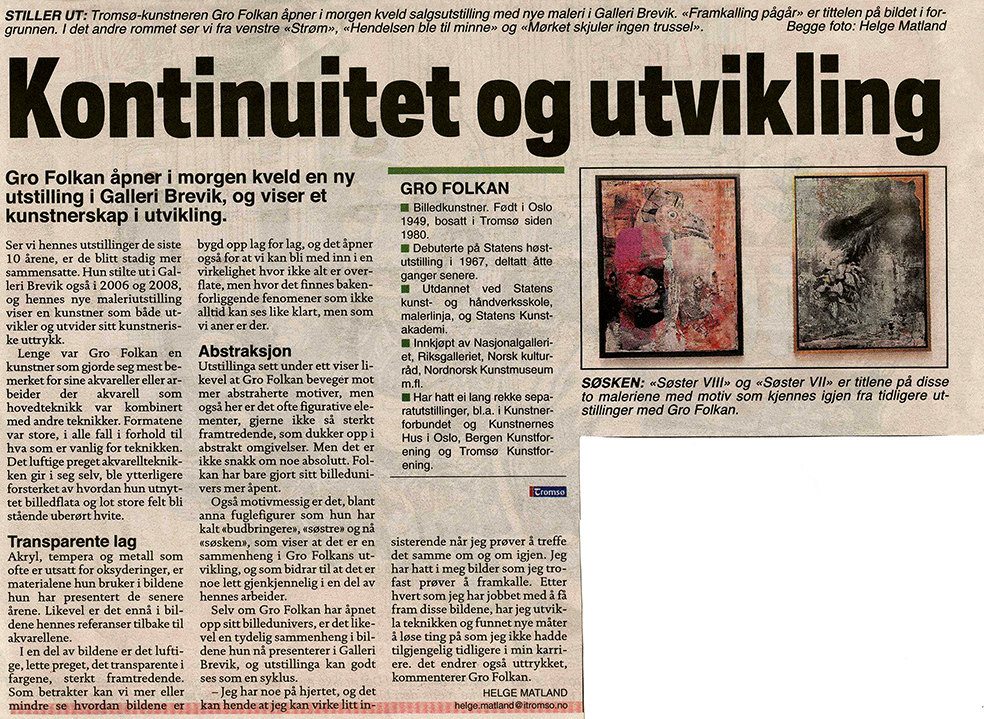
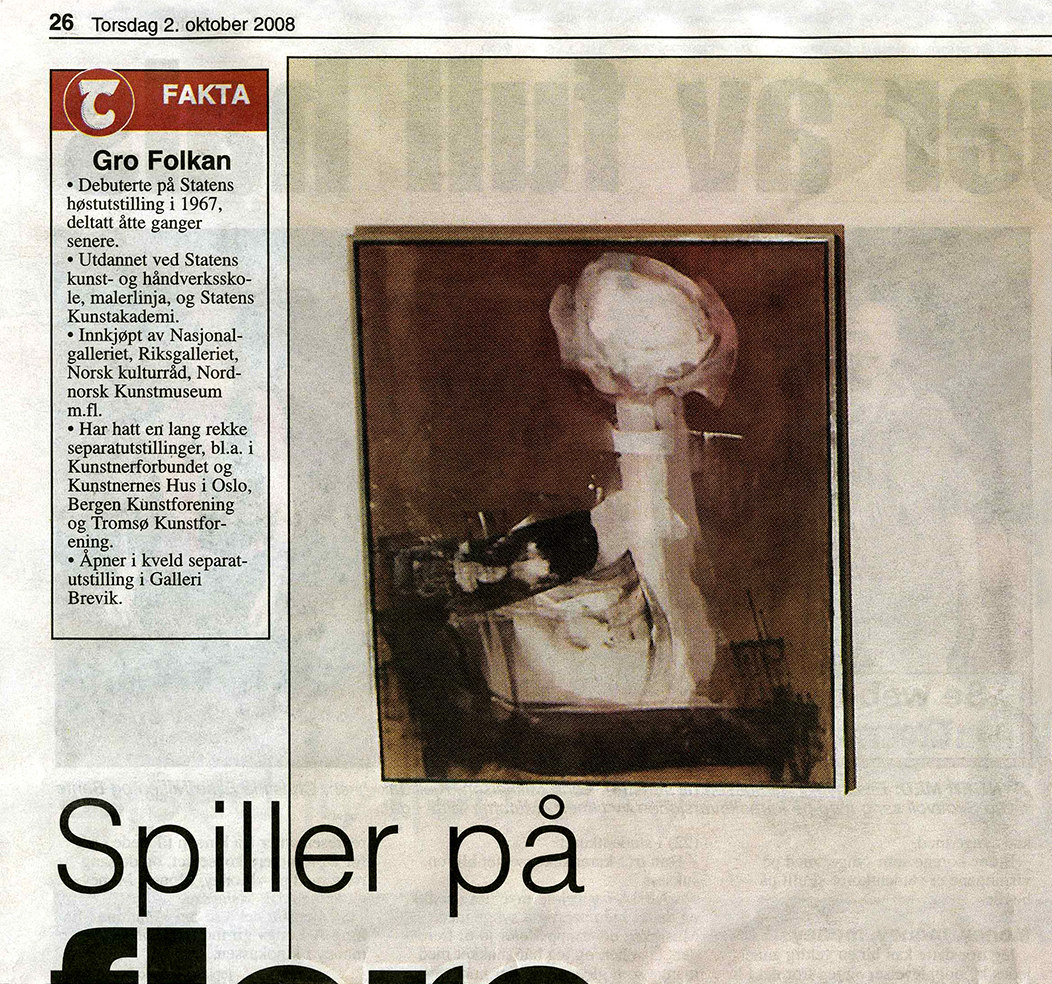
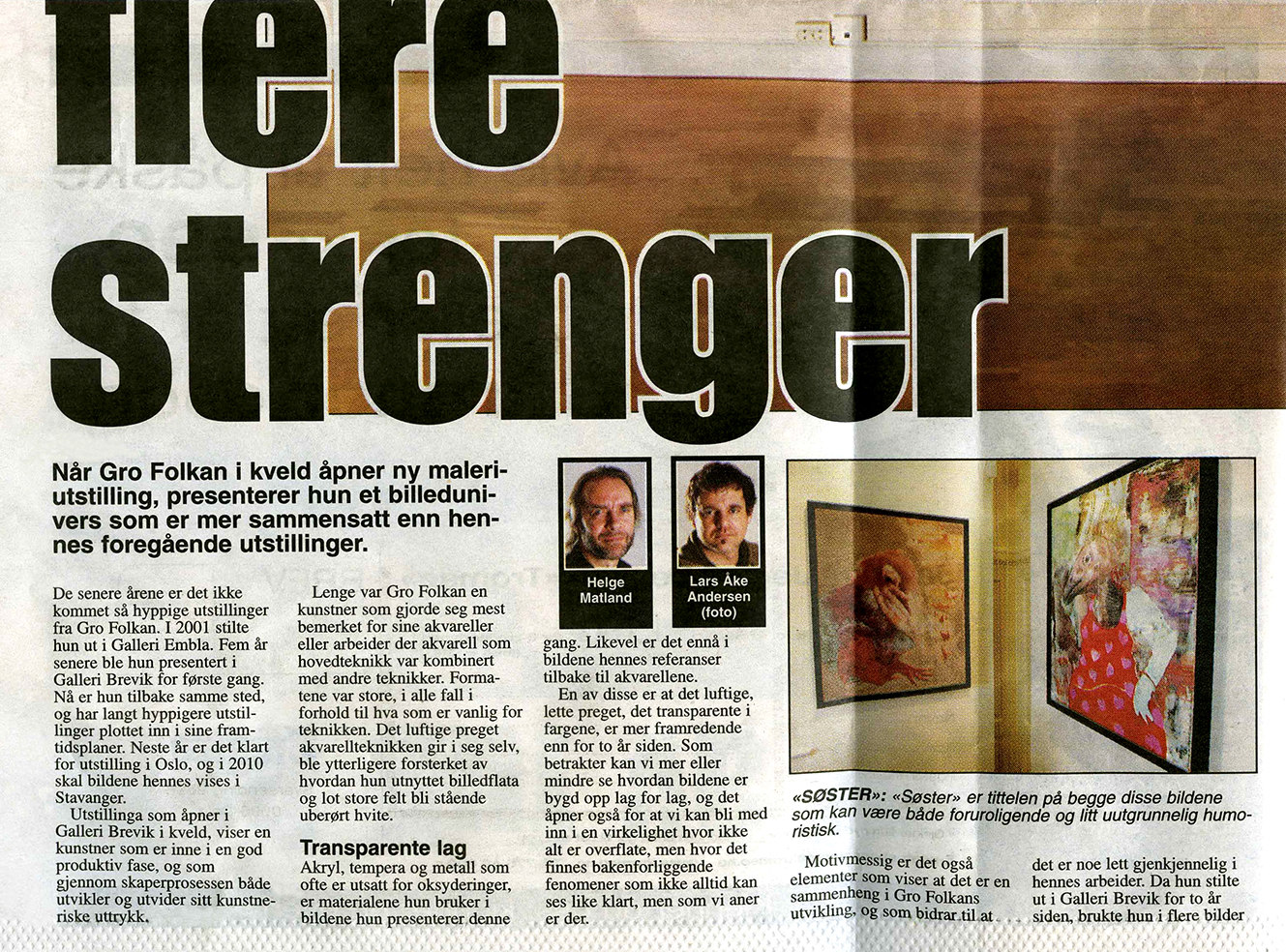
This early work ‘Bird-Transformation’ Gro Folkan captures at a moment when her visual language is still rooted in the fluidity of gesture and the immediacy of watercolor. The bird, never fully literal, always on the threshold of abstraction, becomes a metaphor for the artist’s lifelong preoccpation with states of becoming. Watercolor, with its transparency and uncontrollable diffusion, mirrors, the theme: identity is not fixed but dissolves, reforms, and hovers between form.

The watercolor painting suggests a world where boundaries are porous, where the human and the animal, the inner and the outer, the visible and the invisible coexist in a single breath. It is a poetic declaration that transformation is not an event but a condition of being.

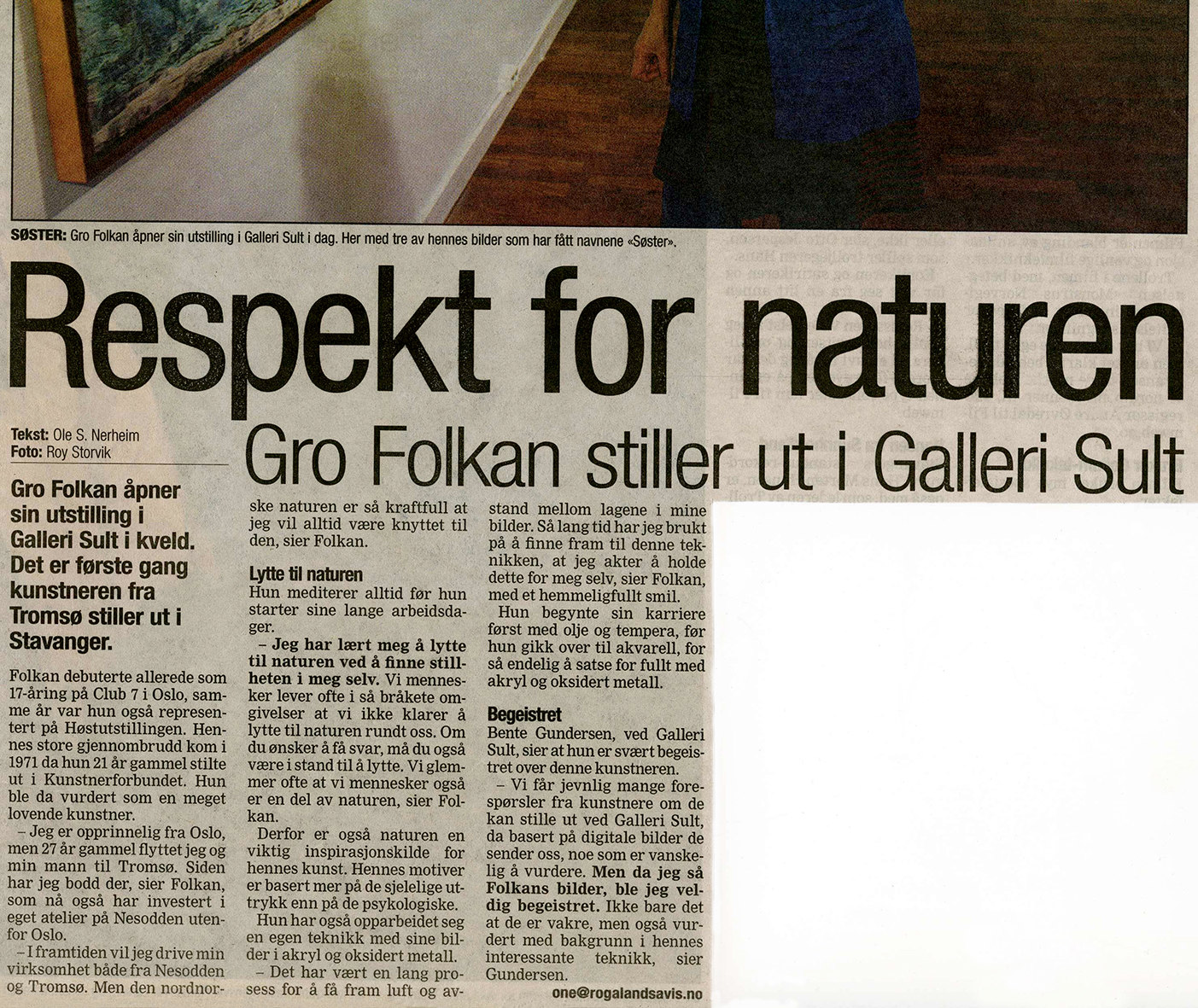
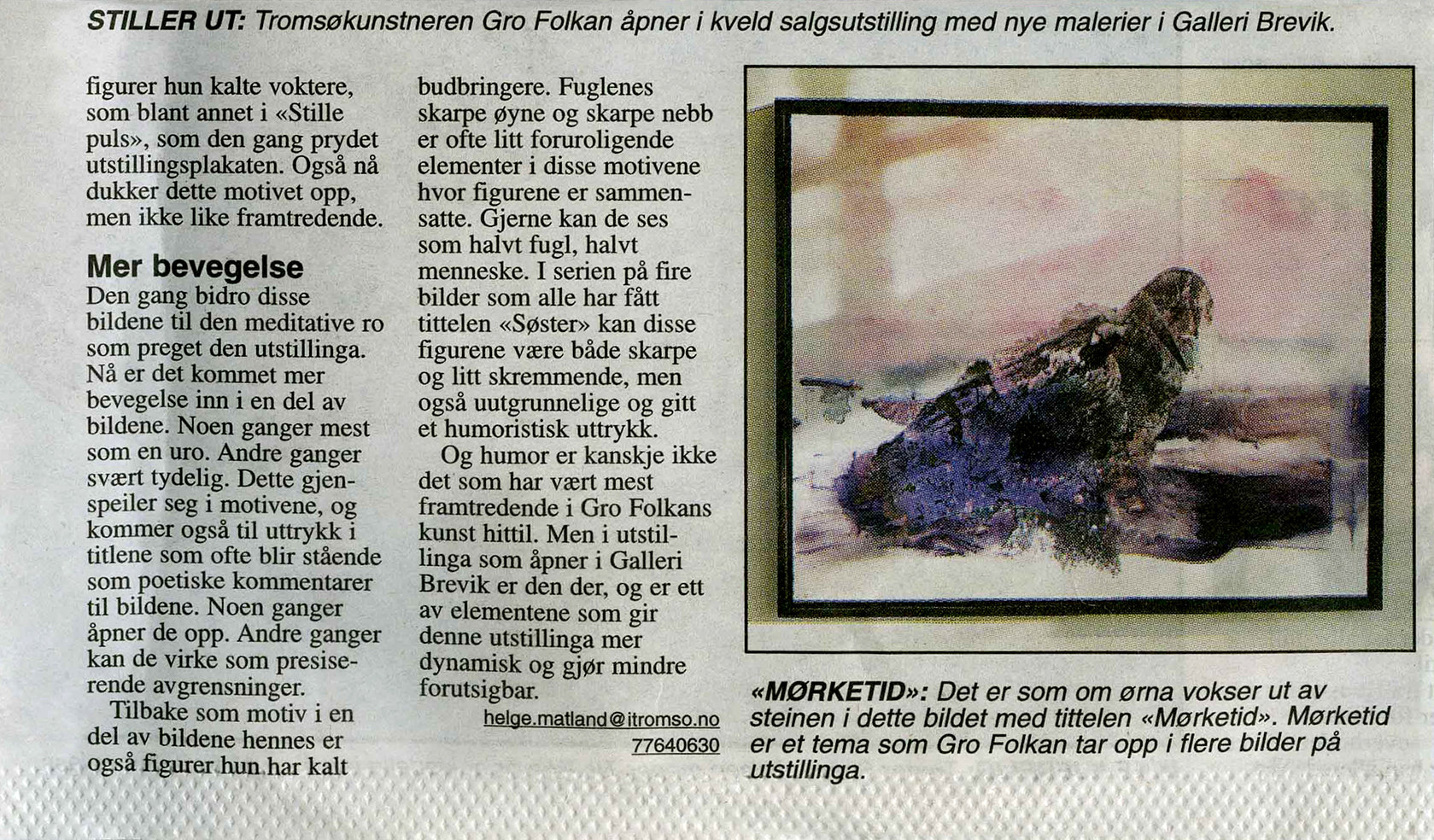
Two decades later in ‘Rest in Itself’, Folkan’s work has shifted from the etheral to the materially resonant.The introduction of metal, aluminium,copper, metal dust, marks a decisive expansion of her vocabulary. Here, transformation is no longer only spiritual or symbolic, it becomes physical, embedded in the very chemistry of the surface. The title, ‘Rest in Itself’, evokes a paradox: a surface that appears still yet vibrates with internal tension. The metals oxidize, reflect,and refract light, creating a living skin nthat changes with the viewer1s position and with time. Folkan’s interest is in alchemical processes becomes evident.: matter is not inert but charged with memory, energy, and potential. This work stands as a meditation on inner equilibrium, a moment where transformation pauses, not to end, but to gather strength.

Gro Folkan’s art becomes a long meditation on how form changes, how matterremembers, and how the human spirit perceives the invisible forces that animate the world. Her use of metals, oxidizing, shimmering, shifting, suggests that even the most solid materials are in constant flux. Her titles reinforce this: transformation, rest, listening. They form a trilogy of becoming, being, and perceiving.

What makes these works compelling is not only their visual beauty but their philosophical depth. Folkan invites the viewer to inhabit a world where everything is alive, everything is in motion, and everything, whether bird, metal, or color, participates in the same universal pulse.

(Petru Russu, The Editor)

Petru Russu is the editor for the art magazine World of Art and the book series Masters of Today